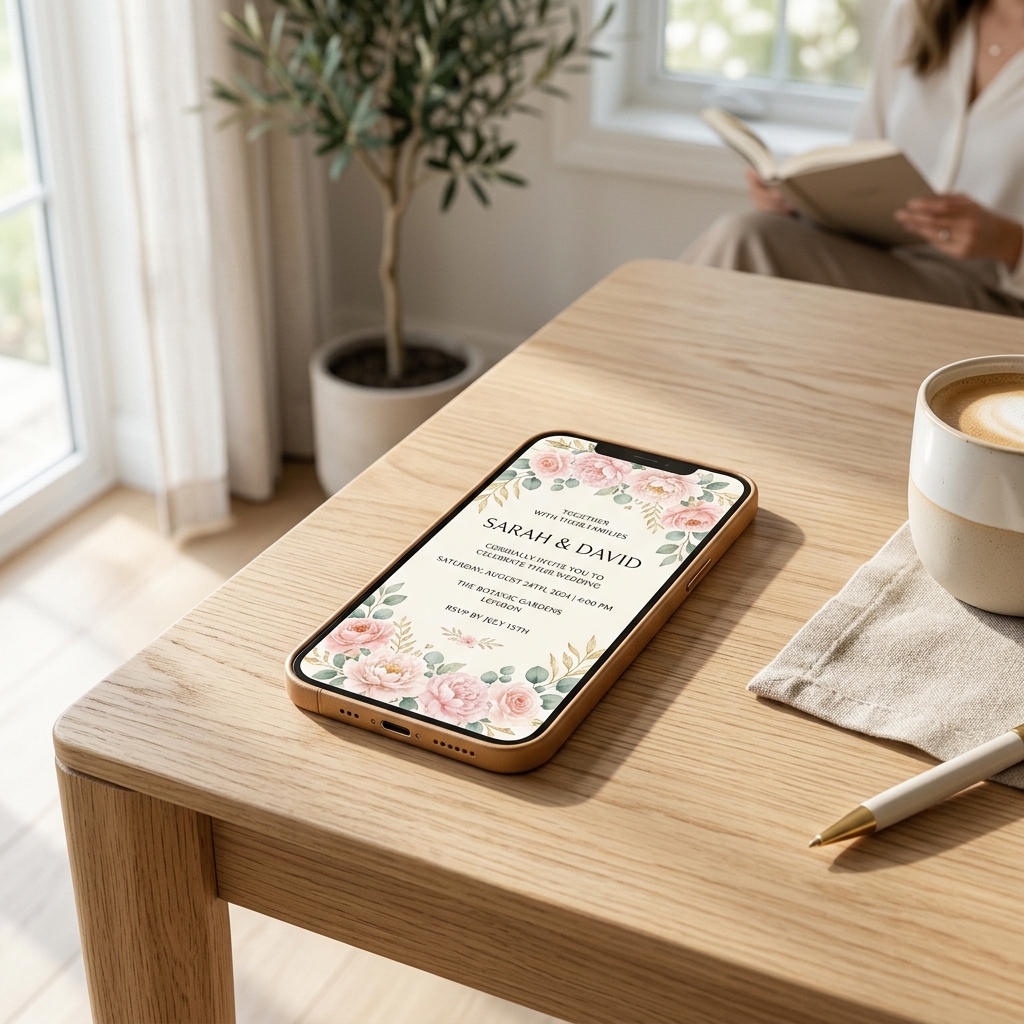
Are digital invitations rude?
No, and the belief that they are is a decade out of date. Formality was never really about paper; it was about care. A digital invitation with considered design, correct names, complete details and a proper request line honors a guest more than a rushed card ever did. The medium carries the message; it isn't the message.
The practical case has also become hard to argue with. Digital invitations arrive instantly, can't be lost by the mail, update themselves when the shuttle time changes, and collect replies without a single stamped envelope making a round trip. For hosts, the difference isn't aesthetic, it's whether the head count assembles itself or has to be chased.
Paper still has real territory: the heirloom wedding suite, the letterpress keepsake, tradition-minded relatives. Nothing about going digital forbids sending paper to the twelve people who'd treasure it. Etiquette has simply stopped requiring it for the other hundred.
What makes a digital invitation feel considered?
The same things that always made invitations feel considered: it's addressed to the guest by name, it looks like someone cared, and it tells them everything they need to know. An invitation that opens with “Dear Maya” lands entirely differently from a link labeled “you're invited lol”, even when the party behind it is identical.
Completeness is part of the courtesy. Date, start and end time, exact address, what to wear, what to bring, who to reply to and by when, every gap becomes a question in your messages, multiplied by the guest list. A finished invitation is a kindness to both of you.
The anti-pattern to avoid is the bare link dumped into a thread with no greeting and no context. It isn't rude exactly, it's just indistinguishable from spam, and it gets treated accordingly. Sixty seconds of personal note fixes it entirely.
Should you send invitations in a group chat?
For anything beyond pizza night: no. A group chat exposes your whole guest list to everyone on it, scatters the replies into a conversation you'll be scrolling for weeks, and lets your invitation drown in fifty messages of side chatter by dinnertime. It also guarantees the awkward moment when someone notices who else was, or wasn't, on the thread.
Individual delivery solves all of it. Sent by email, or by a personal link you share over WhatsApp or text, each guest receives their own invitation, addressed to them, and replies privately, no reply-all, no comparing notes, no performance. On HeyVite, every guest gets their own private link to their own invitation, and with guest privacy the default on every plan, free ones too, nobody browses who else is invited or how they replied unless you deliberately open the event to a share-anywhere link.
The one legitimate group-chat use: the hype thread after invitations have gone out and replies are in. Celebration in public, logistics in private, that's the rule.
What should the message with the invitation say?
Short, warm, specific. By WhatsApp or text: “Maya! Leo is turning five and it wouldn't be a party without you, here's your invitation 🎈 [link]”. By email, put the essentials in the subject line: “You're invited: Sam & Priya's wedding weekend, Sept 12–14” outperforms a mysterious “Special invitation inside…” because guests can see at a glance it's real, personal and worth opening.
For the guests who matter most, grandparents, the best friend flying in, add a line that exists only for them: “It would mean the world to Dad if you were there.” Personalization is the digital equivalent of hand-addressing the envelope, and it takes ten seconds per guest for the handful who warrant it.
Resist the urge to pre-apologize (“sorry for the e-vite!”). It undermines a perfectly gracious invitation and plants a doubt no guest actually had.
How do you include guests who aren't online?
Every list has a few: the great-aunt without a smartphone, the neighbor who checks email monthly. Do one deliberate pass over your list and flag them, it's five minutes that prevents the worst etiquette failure available, which is a guest who never knew they were invited.
For those few, go analog with intention: a phone call, a mailed card, or both. A call is not a lesser invitation, for many older guests it's the warmest one possible. Take their RSVP on the spot and enter it into your tracker yourself, so the count stays complete in one place.
A useful pattern for family events: deputize a relative. “Can you make sure Grandma has the details and let me know if she's coming?” turns your least-connected guest's invitation into a personal visit, which is usually an upgrade.
Can you post the invitation on social media?
For private events, don't, before or after. Posting the invitation publicly invites self-invites, shows people they weren't invited in the most public way possible, and hands out details (your home address, a date you'll be away) that were never meant for an audience. The party photos can be public later; the invitation never should be.
The same logic applies to forwarding. A personal invitation link is addressed to one guest, it isn't theirs to pass along, and a well-designed system makes that structural: each link opens that guest's invitation, not a general-admission door. If a guest wants to bring or suggest someone, the route is asking the host, exactly as it always was.
Truly public events, an open studio, a fundraiser, a community concert, invert the rule: post everywhere, and use a public RSVP page rather than personal links. The etiquette follows the guest list: private list, private delivery.
How do you follow up digitally without nagging?
The advantage of digital follow-up is that it can be precise: only the guests who haven't replied, only when it matters. One friendly nudge a few days before the RSVP deadline and one direct note after it resolves almost everything, especially when the reminder lets guests reply in the browser, no account needed. RSVP reminders send in one click when the day comes, nudging only the guests who haven't replied, and no one else.
Change channels for the human touches: invitation by email, nudge by text, final holdout by phone. Each escalation reads as increasing care rather than increasing pressure, which is exactly the tone you want. For the complete playbook, schedules, scripts and the 48-hour rule for the permanently silent, see our guide to getting guests to actually RSVP.