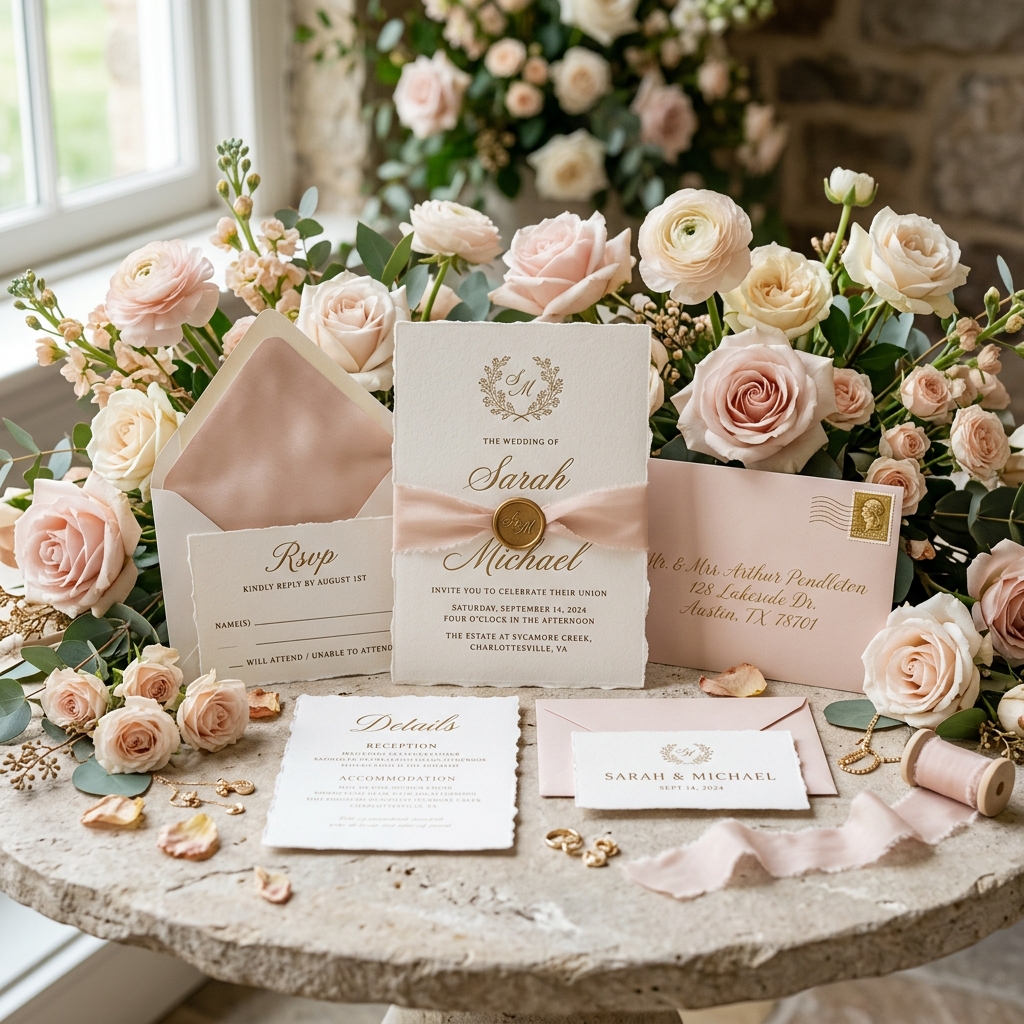
What has to be on a wedding invitation?
Six elements, in roughly this order: the host line (who is inviting), the request line (“request the pleasure of your company”), the couple's names, the date and time, the venue, and the reply instructions with a deadline. Everything else, schedule, travel, attire detail, registry, belongs on a details page or your wedding website, not the card.
The discipline pays off twice. Visually, a card carrying six lines breathes; a card carrying sixteen looks like a flyer. Practically, details change, shuttle times, brunch venues, hotel blocks, and you want them living somewhere you can update, not printed somewhere you can't.
Dress code is the one common extra that earns its place, as two or three words in a lower corner: “Black tie,” “Cocktail attire,” “Garden party, flat shoes advised.” If it needs a paragraph, it goes on the website with everything else.
How do you word the host line?
The host line names whoever is giving the wedding. Traditional, when one set of parents hosts: “Mr. and Mrs. Alan Reyes request the pleasure of your company at the marriage of their daughter…” When both families contribute, the modern norm, “Together with their families” sits gracefully above the couple's names and flatters everyone without an audit of who paid for what.
Couples hosting themselves simply lead with their own names: “Priya Sharma and Samuel Ortiz invite you to celebrate their marriage.” Divorced parents co-hosting are listed on separate lines, never rejoined as “Mr. and Mrs.”; a remarried parent's spouse appears beside them if they are hosting too.
When in doubt, remember what the line is for: gratitude and clarity, not genealogy. “Together with their families” resolves nearly every complicated situation with grace, which is exactly why it has become the default.
What's the difference between “honor of your presence” and “pleasure of your company”?
“The honor of your presence” is traditionally reserved for a ceremony in a house of worship; “the pleasure of your company” covers everything else, hotels, gardens, barns, city halls and living rooms. It is the invitation world's oldest code, and older guests will still read it fluently.
Neither is more correct in any absolute sense, and the British spellings, honour, favour, are an optional flourish some American couples keep for tradition's sake. Choose one register and stay in it: a formal request line followed by “party starts at 6!!” gives your guests tonal whiplash.
Should you put the registry on the invitation?
No, this is the one traditional rule that has survived every modernization, because the logic still holds: an invitation asks for someone's presence, and printing where to buy gifts on the same card converts an honor into a transaction. Even guests who would never articulate the rule can feel the difference.
The modern solution is cleaner anyway: registry details live on your wedding website, one tap from the invitation, alongside the schedule, travel notes and RSVP. Guests who want to give will find it in seconds; the invitation itself stays about them, not about gifts.
The same placement applies to honeymoon funds and cash registries, welcome on the website, phrased warmly (“your presence is the real gift; if you'd like to contribute to our honeymoon…”), and to “no gifts, please,” which is fine to print on informal invitations but still reads best on the details page of a formal one.
How do you say adults only politely?
Warmly, briefly, and without apology: “We love your little ones, but this will be an adults-only celebration.” One sentence on the details page or website does it. Alternatives in the same spirit: “So everyone can relax and stay late, this will be a grown-ups' evening” or simply “Adult reception to follow.”
The invitation's addressing does the quiet work: the people named are the people invited. “Anna & David” means the parents; if children were coming, they would be named. Etiquette-fluent guests will read it correctly, the written line is for everyone else, and it prevents far more awkwardness than it creates.
When someone asks for an exception, answer like it's a policy, because it is: “We decided on no kids across the board, one exception and we'd owe ten more. We'd truly love to have you both if you can make it work.” Sympathy, consistency, no negotiation. Nursing infants are the one exception nobody will begrudge.
How should you handle the RSVP?
Give a deadline three to four weeks before the wedding, stated as a date, and make the reply method effortless. Digital RSVP is now standard at every level of formality, even couples sending letterpress on cotton paper include a website or QR code, because typed replies arrive faster, read unambiguously, and never get lost in a mail pile.
Ask only what you'll act on: attendance, meal choice if plated, dietary needs, plus-one name. A song request is a charming optional fifth; a tenth question is how forms die half-finished. We've written a full guide to which RSVP questions to ask and the exact wording for each.
Expect a slice of the list to need a nudge regardless of how beautiful the invitation is, build one reminder into the plan a few days before the deadline, addressed only to those who haven't replied, one click when the day comes, and most of the silence clears.
Is a digital wedding invitation acceptable?
Yes. What formality actually requires is care, considered design, correct names, complete details, a proper request line, and every one of those travels perfectly in a digital invitation. What guests remember is how the invitation made them feel, not the postage.
Many couples now run a hybrid: paper for the heirloom moment, digital for everything the paper can't do, instant delivery to the guests abroad, replies that tally themselves, updates that don't require a reprint. Others go fully digital and put the savings into the party. Both are, at this point, simply normal.
Where digital quietly outclasses paper is the wedding weekend itself. The welcome dinner, the ceremony, the farewell brunch, each with its own guest list, become one invitation with sub-events (different parts of your event, such as a ceremony and a reception), where every guest sees exactly the parts they're invited to and replies to each. Paper never solved that; it just sent three cards.
When does everything go out?
The condensed calendar: save-the-dates six to twelve months ahead (a full year or more for destination weddings), invitations six to eight weeks out (ten to twelve for destination), RSVP deadline three to four weeks before the day, final counts to vendors about two weeks out.
Every one of those numbers has a reason behind it, and a bit of flexibility in practice, the full logic, including what to do when you're running late, is in our guide to when to send invitations.